A common piece of advice for AI search is to publish your own data. We looked at whether it shows on UK mortgage searches. For every search in October, we compared the pages Google's AI Overviews cited with the pages in Google's top 10 that they left out, and looked at what was in each page, down to where the cited excerpt sits. Then we looked at the step after: when a brand's site is cited, is the brand also named?
Key takeaways
Pages with data a site presents as its own were not cited more often.
On short keywords, pages whose title uses the words of the search were cited more often than other pages of the same site, and stayed cited more often.
AI Overviews most often take their excerpts from the top of the page, and otherwise often from the FAQ.
Most citations went to pages outside Google's top 10.
AI Overviews named the brand in fewer than half the citations of its site.
On long questions, about half the brand mentions came without the brand's own site among the sources.
What we looked at
We used two sets of UK mortgage searches. The first is the 500 most-searched non-brand mortgage keywords in the UK, from Google's Keyword Planner, which we searched on Google UK every Wednesday in October: four readings. The second is our own set of 500 questions, put to Google UK on 14 and 28 October: two readings.
For each search, we analysed two groups of pages: the pages the AI Overview cited, and the pages in Google's top 10 that it did not cite. We then checked the same features in both groups: the title, the date, an FAQ, a table, data the site presents as its own, signs of expertise. We also compared pages from the same website, so that a brand's reputation is the same on both sides of the comparison.
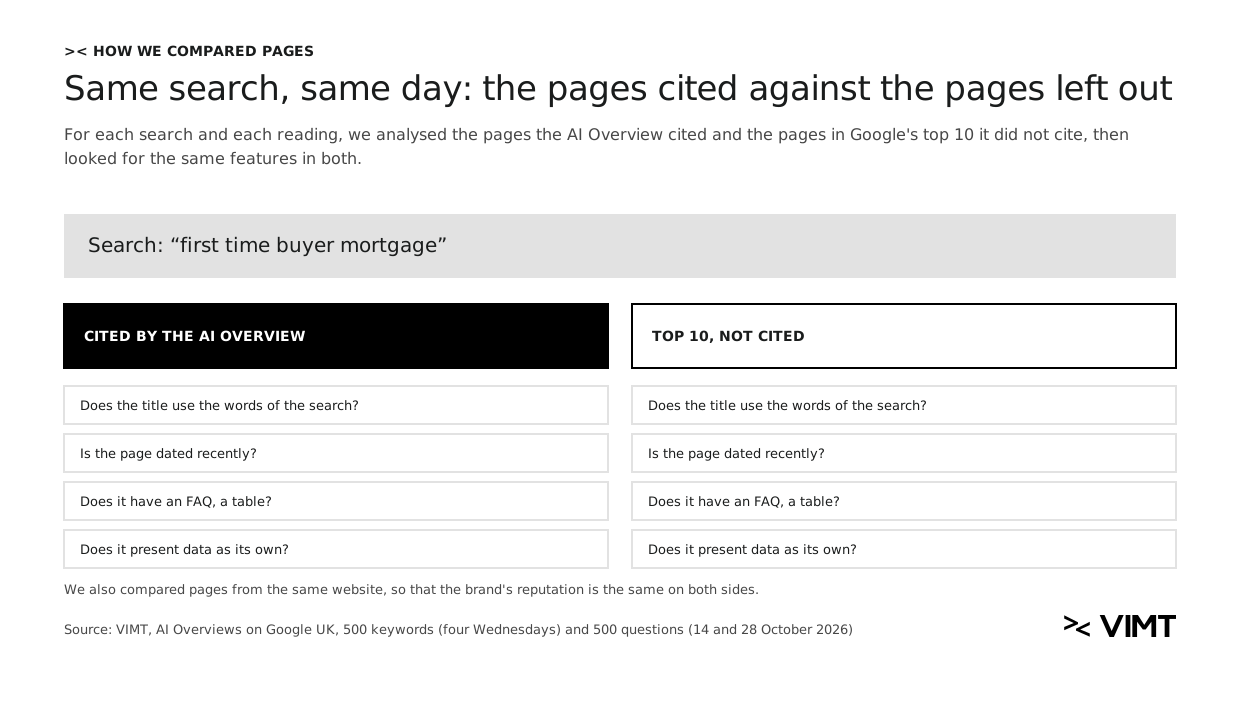
In the tables below, a gap is in percentage points: how much more often a feature appears on cited pages than on comparable pages left out. "Clear" means the gap held when we re-ran the comparison on many random draws of websites (a 95% interval that excludes zero); "no clear gap" means it did not.
1. Own data showed no clear gap
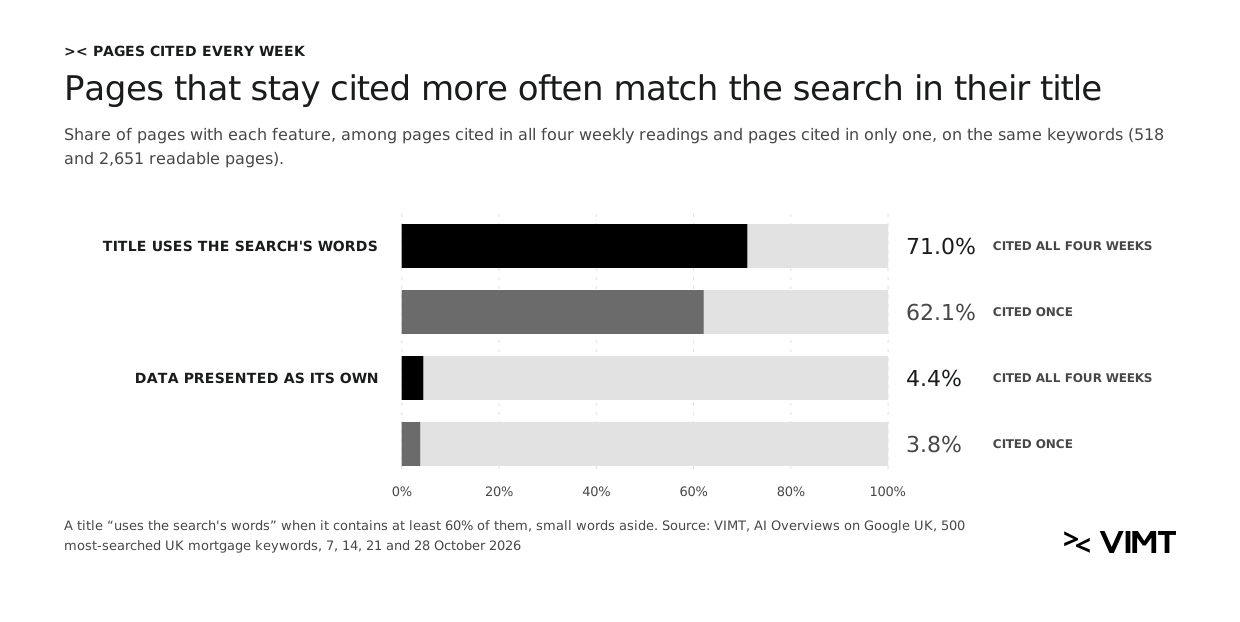
Few pages present data as their own, with phrases such as "our analysis of" or "according to our research": fewer than one cited page in 20. The pages AI Overviews left out had it almost as often. Between pages of the same website, there was no clear gap.
| Between pages of the same website | Short keywords | Long questions |
|---|---|---|
| Data presented as the site's own | 0.0 pts, no clear gap | −0.3 pts, no clear gap |
| "Reviewed by" a named person | +1.4 pts, no clear gap once each page counts once | +0.3 pts, no clear gap |
Signs of expertise written on the page, such as "reviewed by" a named person or the author's qualification, showed no clear gap on either set of searches. We also tried to count quotes from named experts, but could not detect them reliably enough to draw a conclusion. Our detection misses more of these features than it adds by mistake, which can shrink a gap; a small effect cannot be ruled out.
No study we read measured the effect of a site's own data on real AI answers; we come back to the lab studies at the end.
2. A title that uses the search's words
On short keywords, the feature that separated cited pages most clearly was the simplest one: a title that uses the words of the search. Across all pages the gap was small; between pages of the same website, it was clear. The page AI Overviews cited had such a title about 10 points more often than the page of the same site it left out, or about 6 points when each page counts only once, however many searches it appears on. The gap held for first-time buyer, rates, process, calculator and bridging searches, and for brokers, lenders and comparison sites.
On long questions, the title showed a small gap of about 3 points, which did not hold once each page counted only once. A question is rarely repeated word for word in a page title.
On the keywords, it was also the only feature that separated the pages AI Overviews kept citing from those they cited once. On the questions, a data table did too, and a date in the last 90 days was less common on the pages they kept citing (−6.9 points).
| Title that uses the words of the search | Short keywords | Long questions |
|---|---|---|
| Between pages of the same website | +10.4 pts, clear | +3.2 pts, no clear gap once each page counts once |
| Between pages of the same website, each page counted once | +6.2 pts, clear | +0.6 pts, no clear gap |
| Pages cited in every reading against once | +7.4 pts, clear | +6.1 pts, clear |
Quick win: give each important keyword a page whose title uses its words. It is one of the features most closely tied to being cited, and to staying cited, on short keywords.
Recent dates, on rate pages above all
On short keywords, a page dated in the last 90 days was cited more often than an older page of the same website. The gap looked largest on rate pages, though with a wide margin. On long questions, cited pages were more often dated within the year. Between pages of the same site, that gap disappeared: on questions, a recent date describes the site as a whole.
| Page dated in the last 90 days | Short keywords | Long questions |
|---|---|---|
| Between pages of the same website | +9.1 pts, clear | −0.3 pts, no clear gap |
| Between pages of the same website, each page counted once | +6.9 pts, clear | +1.7 pts, no clear gap |
A date shown in the text ("Updated…") showed no clear gap on the keywords. On the questions it was slightly less common on cited pages.
Tables and bylines go with the website
Tables were more common on cited pages overall, and author bylines on cited pages within the top 10. Between pages of the same website, neither gap held. Both are typical of the sites AI Overviews often cite, such as comparison sites and the financial press, across all their pages.
| Between pages of the same website | Short keywords | Long questions |
|---|---|---|
| Data table | +1.6 pts, no clear gap | +0.8 pts, no clear gap |
| Author byline | −0.6 pts, no clear gap | +1.2 pts, no clear gap |
3. The cited excerpt sits near the top of the page
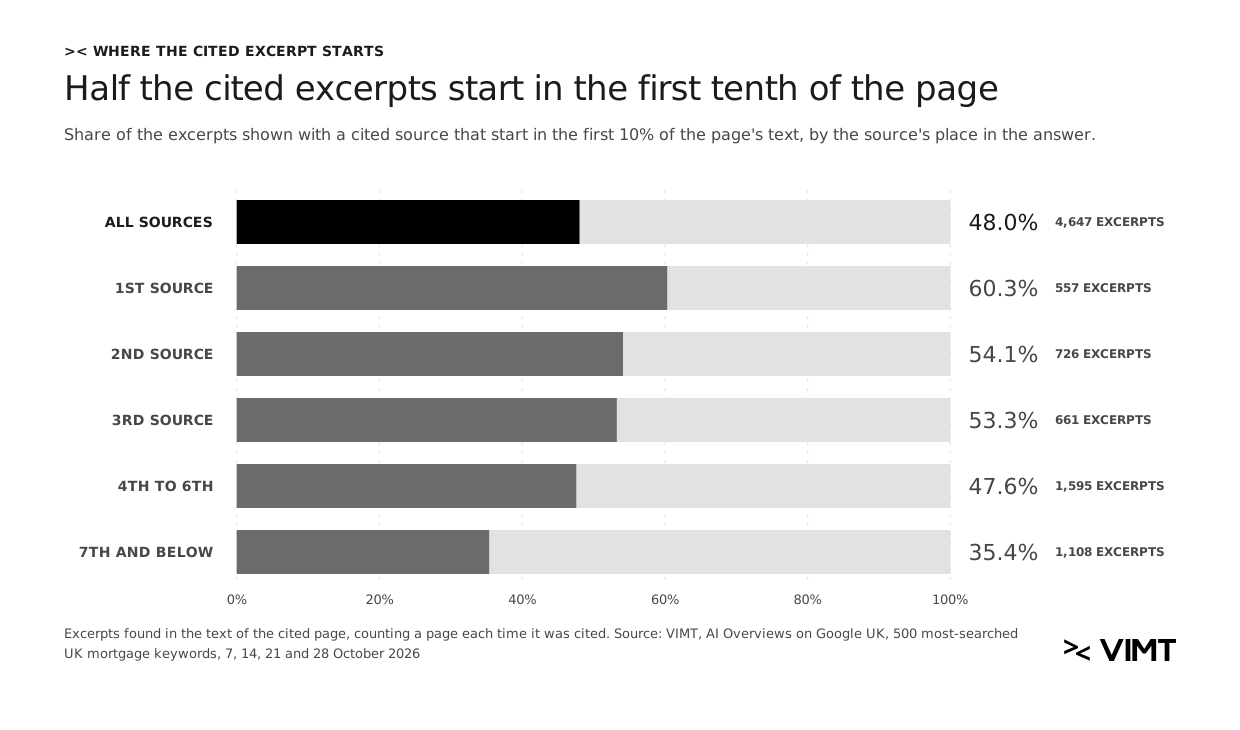
AI Overviews show a short excerpt with each source they cite. We looked for that excerpt in the text of the page it came from. Half the excerpts we found start in the first tenth of the page, and nearly nine in ten in the first half. The higher a source sits in the answer, the more often its excerpt starts at the top: six in ten for the first source, about one in three from the seventh source down.
When an excerpt comes from further down, it often comes from the FAQ. On pages that have one, the excerpts that start in the second half of the page fall in the FAQ more often than the space the FAQ takes would suggest: about six in ten, where chance would give under half.
| Short keywords | Long questions | |
|---|---|---|
| Excerpts starting in the first tenth of the page | 48.0% | 37.0% |
| Excerpts from the first source in the answer that start in the first tenth | 60.3% | 42.1% |
| Second-half excerpts that fall in the FAQ, on pages with one | 63.1% of 328, against 48% by chance | 63.4% of 254, against 41% by chance |
| FAQ, between pages of the same website | +6.4 pts, clear | +3.1 pts, clear |
| FAQ, between pages of the same website, each page counted once | +6.2 pts, clear | +2.2 pts, clear |
On long questions, excerpts sat lower in the page: 37% start in the first tenth, against 48% on the keywords, and the order of sources made less difference. One possible reason, which we did not test, is that the answer to a long question is spread over more of a page.
A "Key takeaways" box at the top of the page, often recommended for AI search, showed no difference in where the excerpts start, though the margin was too wide to rule one out.
Quick win: answer the search in the first lines of the page. That is where AI Overviews most often take their excerpts from, and an FAQ is where the others often come from.
4. Most citations went to pages outside Google's top 10
Most of the citations in AI Overviews went to pages that were not in Google's top 10 for the same search: about three in four on the keywords, more than half on the questions. On the keywords, about one in eleven of those was a video.
| Citations to pages outside Google's top 10 | Short keywords | Long questions |
|---|---|---|
| Share of all citations | 76.7% | 55.6% |
This also sets a limit on the comparisons above: they set cited pages against the top 10 pages left out, while most cited pages sit outside the top 10. Which sites those pages belong to, and which brands they name, is the subject of the next two sections.
Quick win: don't wait for a top 10 position. Most citations go to pages outside it.
5. A citation often comes without the brand's name
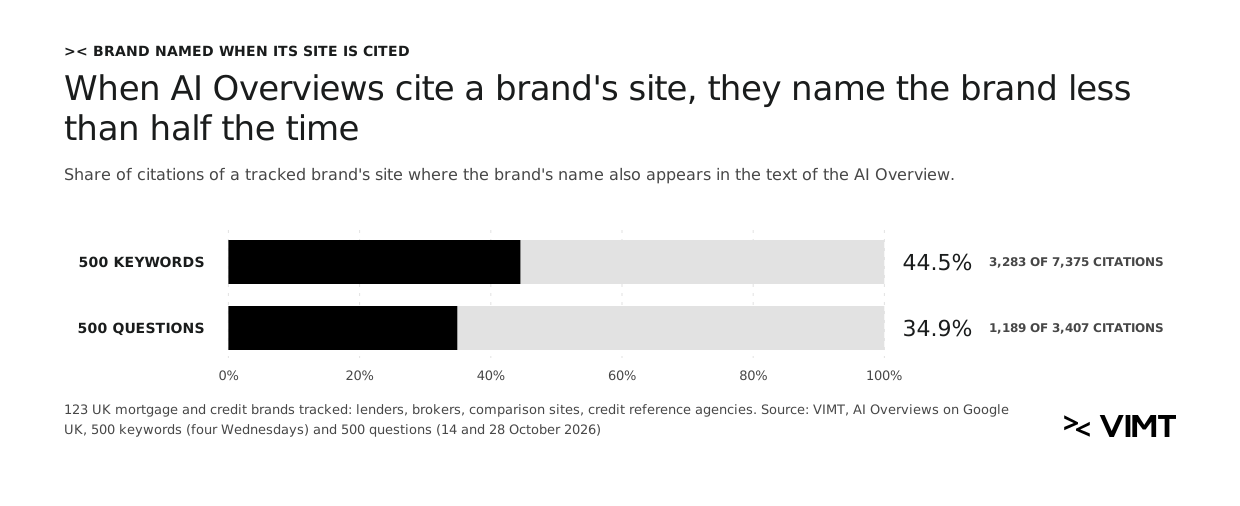
For a brand, a link under the answer and its name in the answer are two different results. When AI Overviews cited a tracked brand's site, they named the brand in 44.5% of cases on the keywords and 34.9% on the questions.
Which of a brand's cited pages came with its name? Among pages of the same brand, the ones cited with the brand's name were less often articles with an author byline, a date and Article markup. That profile fits product and tool pages. When they carried a date, it was more often recent. A title that uses the search's words made no difference here.
| Pages of the same brand cited with its name, against its other cited pages | Short keywords | Long questions |
|---|---|---|
| Author byline | −7.4 pts, clear | −10.0 pts, clear |
| Dated in the last 90 days (dated pages only) | +11.4 pts, clear | +9.4 pts, clear |
Quick win: keep your product and tool pages current. On your own site, they look like the pages most often cited with your name.
6. On long questions, other sites name you
The other way round also happens: a brand is named while its own site is not cited. How often depends on the search. With both sets of searches combined, it was one mention in seven on searches of one or two words, and more than one in two on searches of eight words or more. Part of that slope comes from the mix of searches, since the longer ones are mostly questions. Within the questions alone, the share rises from about a third to 56% for those of eight words or more.
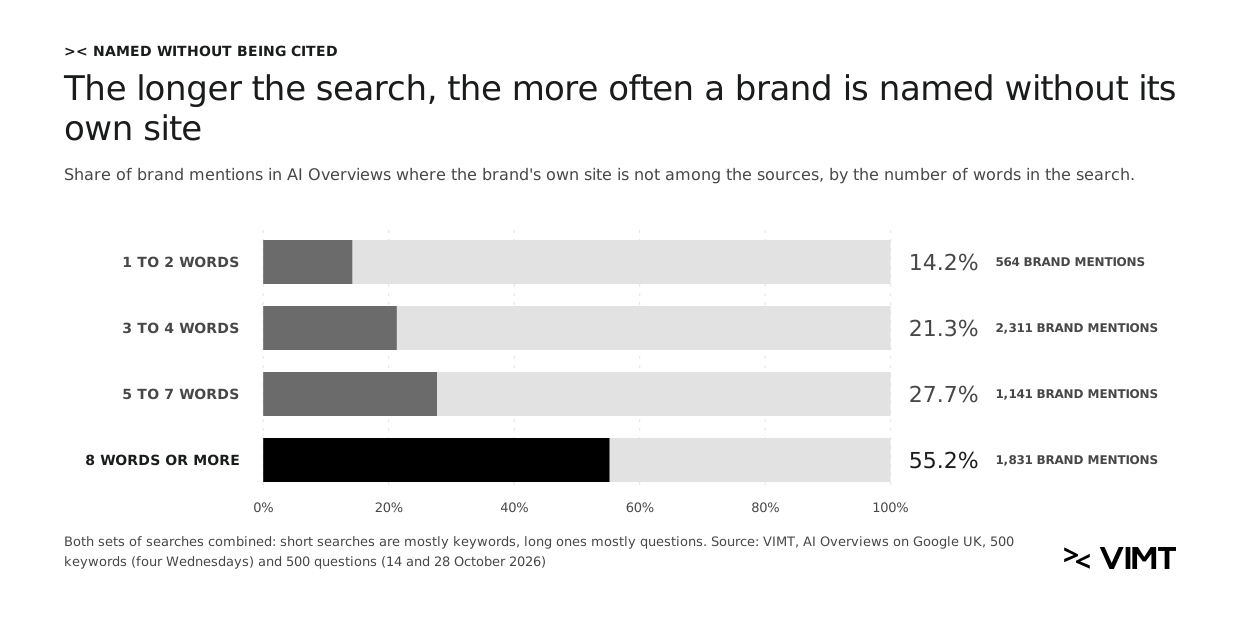
Within each set, comparative searches, the ones with "best", "which", "cheapest", "compare" or "rates", had the highest share. On those, AI Overviews list brands, and the pages cited next to those lists are mostly comparison sites, consumer sites and the press, along with brokers' guides. When the question contained the brand's name, its site was among the sources more often: 64% of the time on the questions, against 47% otherwise.
| Brand mentions without the brand's own site | Short keywords | Long questions |
|---|---|---|
| All searches | 21.0% | 52.3% |
| Comparative searches | 32.5% | 59.5% |
| Other searches | 14.2% | 42.2% |
When a brand was named without its own site, we looked for a cited page in the same answer that carried its name. We found one for two mentions in three. A few sites came up again and again: HomeOwners Alliance first, ahead of Moneyfacts, Which?, MoneySuperMarket and Uswitch. Some brands had one main carrier: Santander most often on Moneyfacts, Yorkshire Building Society on MoneySuperMarket, L&C on Which?.
Some of those pages are listicles, such as "best mortgage rates" or "top brokers" pages. They make up about one carrier page in seven, against about one in fifty of the other pages cited in the same answers (14.8% against 1.8% on the keywords, 13.3% against 2.4% on the questions), and most of them are best-rate pages. Most carrier pages are comparison tables, consumer guides, reviews and brokers' guides that list each lender's rates, fees and criteria. In our September study, pages that rank brokers and lenders appeared in fewer than one answer in ten, pages that list rates or deals in about one in five, and small sites built mainly to host links barely appeared.
At the same page length, the pages that carried those names more often had figures found on no other page for that search, such as rates, fees and criteria by lender, and were more often dated articles with Article markup, and on the questions more often signed. The gap for figures of their own was there on both kinds of search, against the other pages cited in the same answer, though with a wide margin on the keywords. A page that lists rates by lender names brands by nature, so this result describes those pages. It does not tell us why AI Overviews cite them. It is consistent with a correlation Ahrefs found across 75,000 brands: how often a brand is mentioned across the web was more closely tied to its visibility in AI Overviews than its number of backlinks was.
| Pages carrying a brand's name, against other pages cited in the same answer, same length | Short keywords | Long questions |
|---|---|---|
| Figures found on no other page for the search | +11.0 pts, clear, wide margin | +14.7 pts, clear |
Quick win: make sure the sites that list brands in your market have your current figures. On comparative questions, those are the pages cited next to the brands AI Overviews name.
Quick wins
These are associations measured over one month on UK mortgage searches. They come from the comparisons above, most of them between pages of the same website. A change to a page may not have the same effect.
To be cited
- Match the title to the search. One page per important keyword, with its words in the title.
- Answer the search in the first lines of the page.
- Consider an FAQ for the questions around the search: cited pages had one more often, and lower excerpts often come from it.
- Keep rate pages recently dated and up to date.
- Don't wait for a top 10 position: most citations go to pages outside it.
To be named
- Keep product and tool pages current: they look like the pages cited with your name.
- Be on the pages that list brands (comparison sites, consumer sites, the press and brokers' guides), with up-to-date figures.
Pick the kind of search you work on, and see which features went with being cited on it.
Interactive
Which features went with being cited on your searches?
Pick the kind of search you work on.
500 most-searched UK mortgage keywords. What went most with being cited, between pages of the same website: a title that uses the search's words, a recent date and an FAQ.
Getting cited
- Title that uses the words of the searchClear gap
Cited pages had such a title 10.4 points more often than other pages of the same website.
- Page dated in the last 90 daysClear gap
Cited pages were dated in the last 90 days 9.1 points more often than other pages of the same website.
- Title that uses the search's words, on pages cited in every readingSmall gap
Pages cited in every reading had such a title 7.4 points more often than pages cited once.
- FAQ on the pageSmall gap
Cited pages had an FAQ 6.4 points more often than other pages of the same website.
- Data tableNo clear gap
No clear difference between cited pages and comparable pages left out (+1.6 points).
- Data presented as the site's ownNo clear gap
No clear difference between cited pages and comparable pages left out (0 points).
- Citations to pages outside Google's top 10
76.7% of the citations in AI Overviews went to pages not in Google's top 10 for the same search.
Where the excerpt comes from
- Excerpt starting in the first tenth of the page
48% of the excerpts we found in the cited page start in its first tenth.
Getting named
- Figures of their own, on the pages carrying a brand's nameSmall gap
Pages that carried a brand's name had figures found on no other page for the search 11 points more often than the other pages cited in the same answer, at the same page length.
- Author byline, on the pages cited with the brand's nameLess often
Pages cited with the brand's name had an author byline 7.4 points less often than its other cited pages.
- Brand named when its site is cited
When AI Overviews cited a brand's site, they named the brand in 44.5% of cases.
- Brand mentions without the brand's own site
In 21% of brand mentions, the brand's own site was not among the sources.
“Clear gap”: the gap held when we re-ran the comparison on many random draws of websites and when each page counted once, is 8 points or more, and stays above 3 points at the low end of its range. “Small gap”: it held, but is smaller or less certain. “Less often” (striped bar): it held, but the feature was less common on the cited pages. “No clear gap”: it did not hold. Gaps are in percentage points. These are associations measured over one month. A change to a page may not have the same effect.
The 10-slide summary of this study is on LinkedIn, and you can also download it as a PDF.
Methodology
We searched the 500 most-searched non-brand UK mortgage keywords on Google UK on 7, 14, 21 and 28 October 2026, and our 500 mortgage questions on 14 and 28 October, and recorded the sources of each AI Overview and Google's top 10 for the same search. On 3 November, after the readings, we analysed the cited pages and the top 10 pages that were not cited. We retrieved 10,830 of 14,206 pages, 9,713 with readable text, as some sites, including large lenders, could not be read. A page may have changed since it was cited. We compared the two groups on the same search, and again between pages of the same website. Before counting anything, a separate AI reader checked samples of pages blind, without knowing which ones had been cited, to test whether each feature was detected correctly. We dropped the features we could not detect reliably. A brand counts as named when one of its names appears in the text of the AI Overview, for 123 UK mortgage and credit brands, including lenders, brokers, comparison sites and credit reference agencies.
Some limits matter for reading the results. The comparison group is Google's top 10, while most citations go to pages outside it. A date was found on only part of the pages, so the date gaps cover dated pages only. The title threshold, 60% of the search's words, was chosen on the pages we checked. In the main comparisons each observation counts, so a page cited on many searches weighs more; we re-ran the same-website comparisons counting each page once, and report a gap as clear only when it held both ways. We ran many comparisons, so a gap that only just clears zero can be chance. The two sets of searches share many pages and sites, so their agreement counts as a consistency check. The excerpt positions come from an earlier reading of the same pages, on 29 October. Listicles were identified from the page address only, so their share may be a little higher.
What published research found
Our result on own data fits what published research has found so far. A 2024 lab study found that statistics added to a page by a language model made other models use more of its text, but a 2025 replication that measured where pages ranked among the sources found no gain, and a small loss in most settings. Both worked on generated answers in a lab, away from Google's AI Overviews.
What this study does not cover
This study covers AI Overviews only, on UK mortgage searches. Pages built in JavaScript, such as YouTube videos and social media posts, could not be read. We did not measure links or mentions of a brand across the web, only what the cited pages contain. And our questions describe a profile or a topic. Detailed personal cases, which we did not test, may be where a site's own data matters most.