Do the biggest brands in UK mortgages dominate AI Overviews and the LLMs? That is the question we set out to answer. We put 501 questions about the UK mortgage market to Google AI Overviews, ChatGPT and Gemini, three times each.
Rank trackers measure positions in a ranking. Tools that measure the mentions and citations inside AI answers exist too, but they rarely pair each answer with the Google top 10 for the same query, captured in the same call at the same instant. This study does both.
Key takeaways
The three surfaces do not describe the same market. AI Overviews cite a market player in 98% of their answers, ChatGPT in 40%. More than one ChatGPT citation in two points to a public body.
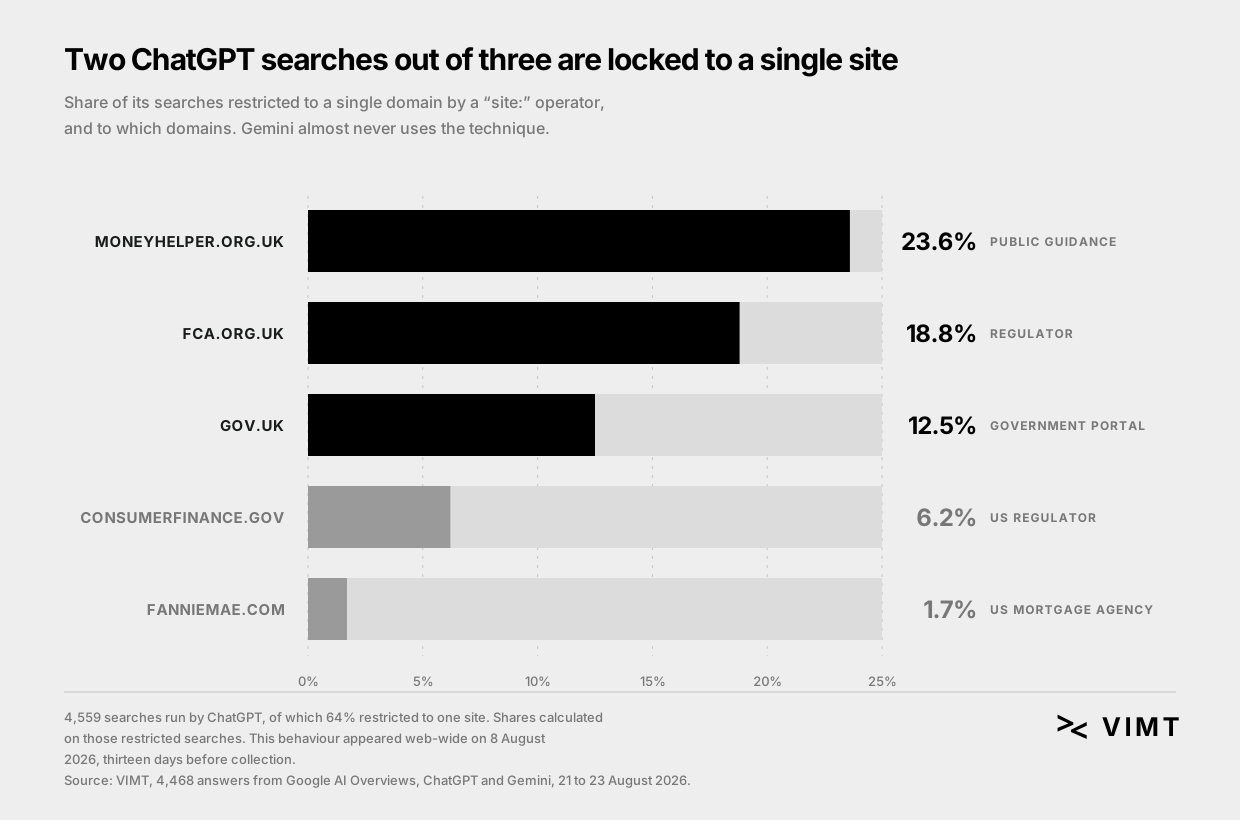
Two ChatGPT searches out of three are locked to a single site, on this market and in this window. They query a single domain, chosen in advance by the model, and almost always a public one. The behaviour is thirteen days old at collection.
Being named and being cited come apart, sharply. Uswitch is a source in 12.2% of answers and is named in only 0.6%. Equifax is named in 5.7% and cited in 1.0%.
The smaller the firm, the less it goes through ranking. When a micro company is cited, six times out of ten it was not in the top 10. For a large firm, once in four.
1. Three surfaces, three markets
Start with the simplest question: do these three systems talk about the same companies?
On the same 501 questions, Google AI Overviews cite a lender, a broker or a comparison site in 98% of their answers. ChatGPT, in 40%. Gemini sits between the two, at 77%.
It is worth pausing on what that means. A UK mortgage business that looks at ChatGPT and finds itself nowhere does not necessarily have a content or a ranking problem. It is looking at a surface that, on this market, barely talks about the companies that sell. Six answers in ten address the question without pointing at a single commercial player.
Where does it look instead? To the state. More than one ChatGPT citation in two goes to a public body: the government-backed money guidance service, the regulator, the government portal.
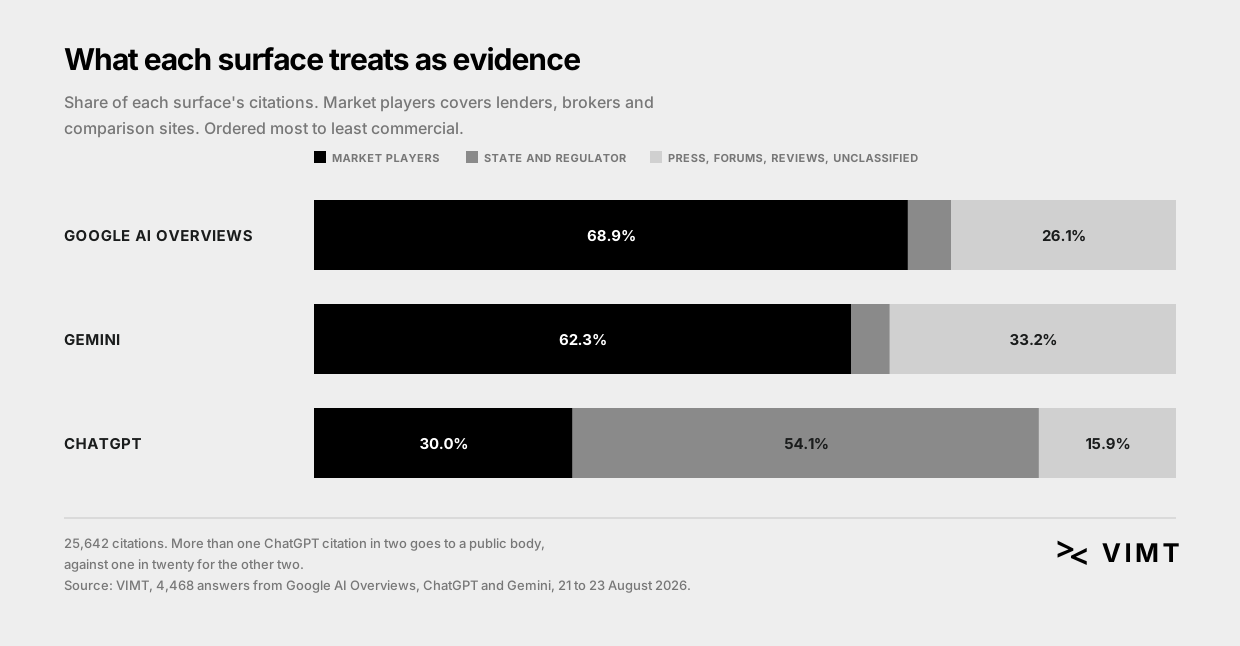 AI Overviews and Gemini look alike: more than six citations in ten go to market
players. ChatGPT is different in kind, not merely in degree.
AI Overviews and Gemini look alike: more than six citations in ten go to market
players. ChatGPT is different in kind, not merely in degree.
This divergence is not a measurement artefact. On the same question, two surfaces share between 8% and 23% of their sources, depending on the pair: ChatGPT overlaps the other two by 8%, while AI Overviews and Gemini, the two closest, still agree on only 23%. To check that the gap was not simply noise, each question was asked three times: a surface repeats its own sources four times more often than it agrees with a rival. The gap is real.
The domains each surface reaches for
The most telling view is, for each surface, the sites it points to most often. The percentage is the share of that surface's own answers in which the domain appears, which is what makes a surface citing 7.7 sources per answer comparable with one citing 3.3.
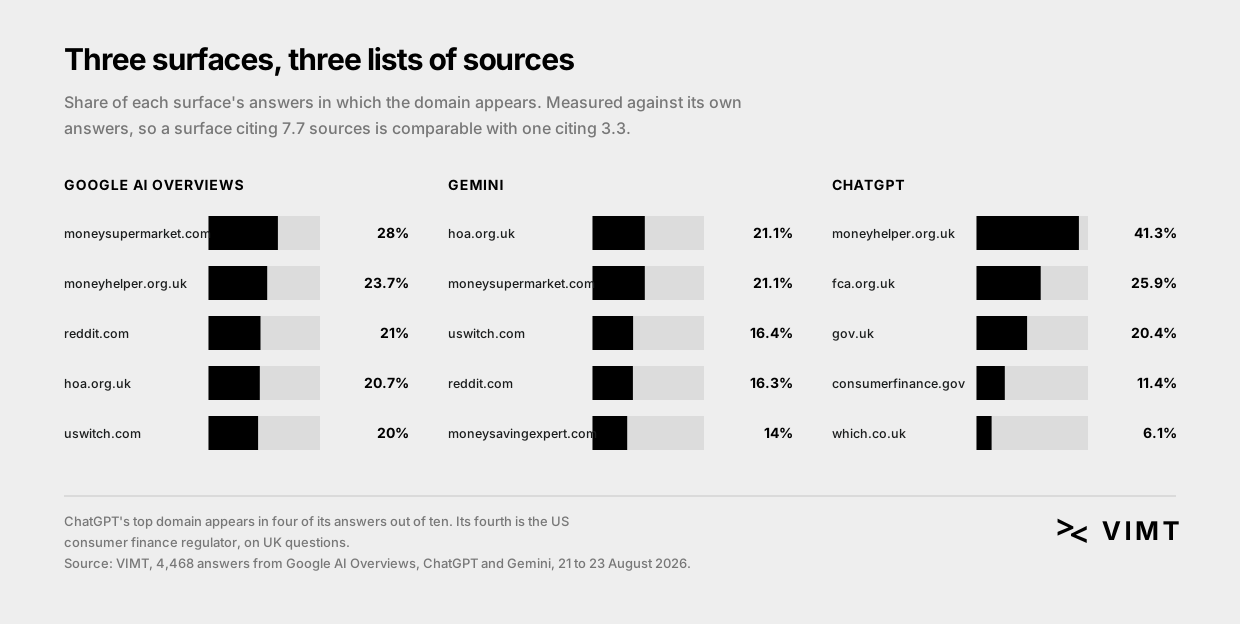 Three lists, three markets. On AI Overviews, a comparison site comes first, followed by
the public guidance service and Reddit. On Gemini, a homeowners' association and a
comparison site. On ChatGPT, the top domain is the public money guidance service,
present in four of its answers out of ten, followed by the regulator and the
government portal.
Three lists, three markets. On AI Overviews, a comparison site comes first, followed by
the public guidance service and Reddit. On Gemini, a homeowners' association and a
comparison site. On ChatGPT, the top domain is the public money guidance service,
present in four of its answers out of ten, followed by the regulator and the
government portal.
And its fourth most cited domain is the US consumer finance regulator, on explicitly UK questions. The cause of that anomaly appears later, and it is more instructive than the anomaly itself.
2. What the engine searches for before it answers
A model that receives a question does not pass it to a search engine as it stands. It breaks it into several queries of its own making, often reworded, sometimes restricted to one named site, then reads the results and writes. Those intermediate queries have a name, query fan-out: the spread of searches a single question triggers.
It is a layer the user never sees, and it decides what the model will have in front of it when it writes.
ChatGPT and Gemini report, with each answer, the searches they ran before writing. Google did not report them in our collection. What follows therefore covers those two surfaces, and 6,379 searches.
First finding, and a counter-intuitive one: ChatGPT searches almost every time, and two and a half times more than Gemini. It triggers a search on 95% of questions, with three searches per answer on average, where Gemini runs 1.2 on 81% of questions.
It is also the surface that cites the fewest sources and names the fewest brands. It searches a great deal and keeps little.
The question asked is not the question searched
Second finding: the model does not search for what it was asked. On ChatGPT, half the words used in its searches did not appear in the original question.
On the question "best mortgage deals uk", four words, it fires this:
- "UK best mortgage rates August 2026 fixed tracker first time buyer remortgage comparison"
- "Moneyfacts UK mortgage rates August 2026 best deals"
- "Which? mortgage rates August 2026 UK"
Some thirty words, a date nobody mentioned, and two publishers named on the model's own authority. Optimising a page for the exact wording of a question therefore means aiming at a target the engine does not use.
Two searches out of three are locked to a single site
Third finding, and the one that explains the rest.
64% of ChatGPT's searches are locked to a single site. They query one domain,
chosen in advance by the model, using a site: operator. Gemini almost never does this: the
technique accounts for about one of its searches in a thousand.
This behaviour is recent, and that changes how to read it. It appeared across the
web on 8 August 2026, thirteen days before this collection, when the share of ChatGPT
searches carrying a site: operator went from under half a per cent to around 17% in a
single day. Our 64% is roughly four times that cross-vertical figure, and this study
cannot explain the gap from its own data. What follows therefore describes a young
behaviour on one market during three days, not a settled property of the model. The
collapse in ChatGPT's Reddit citations flagged in the methodology dates from the same
week.
 Here is what that looks like in practice. Question asked: "Where do I get first time
buyer mortgage advice in the UK?" The three searches fired:
Here is what that looks like in practice. Question asked: "Where do I get first time
buyer mortgage advice in the UK?" The three searches fired:
- "site:moneyhelper.org.uk first time buyer mortgage advice UK mortgage adviser"
- "site:fca.org.uk mortgage adviser register UK regulated mortgage advice"
- "site:gov.uk first time buyer mortgage advice UK"
On a question that asks where to find advice, all three searches are locked inside three public sites. No broker can appear there, whatever its ranking, whatever the quality of its pages, whatever its budget.
This matters and it is worth stating plainly. ChatGPT's 54% of public citations are not a preference emerging from a comparison. The model decides, before searching, that the answer lives at MoneyHelper, at the FCA or on gov.uk, then restricts its search to those sites. A missing brand was not dismissed after review: it was never in scope.
The same mechanism explains the US sources. ChatGPT types site:consumerfinance.gov,
site:fanniemae.com and site:hud.gov on UK questions, 277 times. This is not a
geographic confusion in the index, it is a choice made by the model.
The qualification that matters: a third of its searches stay open to the web, and on those it names private players, Moneyfacts, Which?, Skipton, Barclays. The constraint therefore depends on the question. This study does not measure what triggers it.
3. Being named and being cited are two different things
An AI answer does two distinct things. It names companies in its text, and it leans on pages listed underneath as sources.
When an answer writes "L&C is a fee-free broker", that is a mention. When it links
to landc.co.uk as evidence, that is a citation.
These two acts do not follow the same rules, and the same brands do not win both. Everything that follows in this section rests on that distinction.
Take the extreme cases. Uswitch is a source in 12.2% of answers and is named in only 0.6%. Money.co.uk, a source in 7.7% of answers and named in 0.04%. Which?, a source in 6.0% and named in 1.1%.
The other way round, Equifax is named in 253 answers and cited in only 46, five times fewer. TransUnion is named 235 times and cited three. Santander is named three times more often than it is cited.
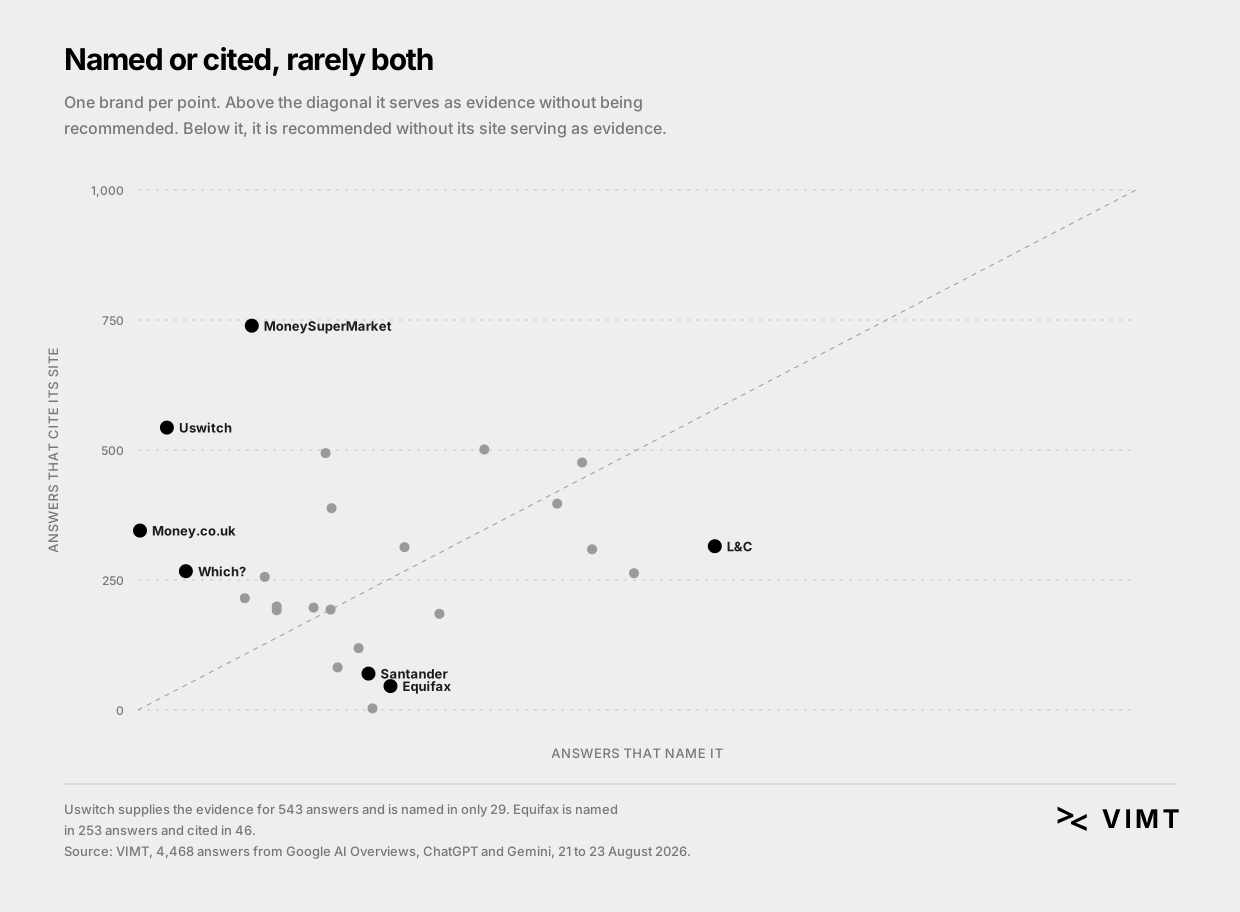 The mechanism differs in each direction, and that is what makes the two levers
separate.
The mechanism differs in each direction, and that is what makes the two levers
separate.
Being cited rewards linkable evidence: a precise, quantified, current page the model can point at. Which? and Uswitch produce exactly that, structured comparisons that are easy to point to. They serve as raw material.
Being named rewards a familiarity the model already holds, independent of any page. Equifax does not need to be sourced to appear in a sentence about credit scoring: the model knows what Equifax is.
The overall source ranking says the same thing another way. The six most cited domains on this market are, in order: the public money guidance service, a comparison site, Reddit, a homeowners' association, the government portal and the regulator. The first lender comes seventh.
In other words, none of the first six is a lender.
A mention up front is not a mention at the end of a list
A mention is not worth the same everywhere. A brand named in the first sentence and a brand relegated to the end of a list each count as one mention, yet a reader does not treat them the same way.
By locating each name in the text, you can count the words a reader travels before meeting it. All the figures that follow are medians: half the time, the brand appears before that threshold.
For reference, an answer runs to 231 words at the median on AI Overviews, 377 on ChatGPT, 475 on Gemini. And the very first brand in an answer, whichever it is, arrives after 37 words on AI Overviews, 48 on ChatGPT, 86 on Gemini.
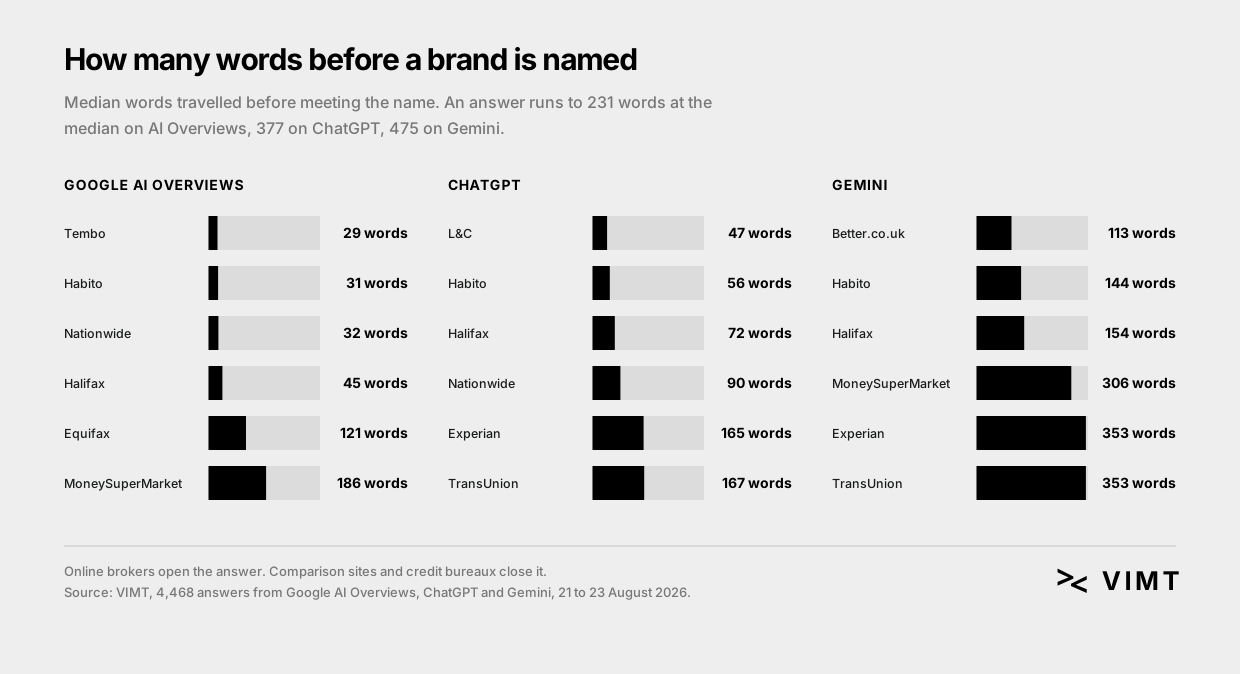 Three things come out of these figures.
Online brokers open the answer. On AI Overviews, Tembo appears after 29 words and Habito after 31, ahead of Nationwide and Halifax. On ChatGPT, L&C opens at 47 words. It is not the largest firms that are named first, and that is the first sign of what the next section shows.
Comparison sites bring up the rear. MoneySuperMarket arrives after 186 words on AI Overviews and 306 on Gemini, later than every bank. It is the exact counterpart of the point made earlier in this section: these sites supply the evidence, they are almost never the recommendation.
The credit bureaux arrive together, late. On Gemini, Experian and TransUnion share the same median to the word, 353. On ChatGPT they sit at 165 and 167. Medians that close together point to the bureaux being listed one after another, near the end of the answer.
Why AI Overviews write shorter
These differences in length are not a shortcoming of any one surface, they follow from what each is meant to do.
An AI Overview is a block sitting above ten blue links. Its job is to summarise and hand off: it does not need to exhaust the subject, because the page continues below. ChatGPT and Gemini are the opposite, a conversation in which the answer is the destination. Nothing follows, so everything has to be there.
Source density shows it better than length alone:
| Surface | Median length | One source every |
|---|---|---|
| Google AI Overviews | 231 words | 30 words |
| Gemini | 475 words | 75 words |
| ChatGPT | 377 words | 114 words |
An AI Overview points to a source nearly four times as often as ChatGPT, relative to the text written. It is a signpost, not a complete answer.
That changes how the figures in this section read. A brand named after 32 words in an AI Overview and a brand named after 90 words in ChatGPT do not hold the same relative position, which is why each surface's median length is recalled every time.
4. Small firms come in through a door large ones do not use
This is the central result of the study, and it was only possible by capturing the ten organic results in the same call as the AI Overview, on the same query, at the same instant. A match made after the fact, against rankings recorded on another day, would be worthless: those positions move by the hour.
What small means here
No size was inferred from citation counts. The micro and small bands are statutory filing regimes at Companies House: the regime a company is entitled to use depends on its turnover, its balance sheet and its headcount, and it is public. The medium and large bands are our own, assigned from full accounts, published headcount and regulated status. Building societies file with the FCA's Mutuals Public Register rather than Companies House, so their accounts came from there.
| Band | How the band is assigned |
|---|---|
| micro | Micro-entity accounts, the lightest regime, open only to the smallest companies |
| small | Small company accounts, one step up |
| medium | Full accounts, without ranking among the sector's largest employers |
| large | Full accounts with a substantial published headcount, or bank or mutual status |
In this corpus, the micro band gathers one and two-partner firms, often an independent broker and an administrator. The large band gathers the high street banks, the major mutuals and the leading comparison sites.
First measure, raw. Just under two thirds of the sources cited by AI Overviews appear in the top 10 they sit above. Fewer than a third in the top 3. An eighth in first position.
More than a third of what they cite therefore appears nowhere in the ten links below. Where those pages sit further down the ranking, this study cannot say: it captured the top 10 and nothing beyond it.
Second measure, and this is where it gets interesting. That proportion depends on the size of the company, and it depends on it strongly.
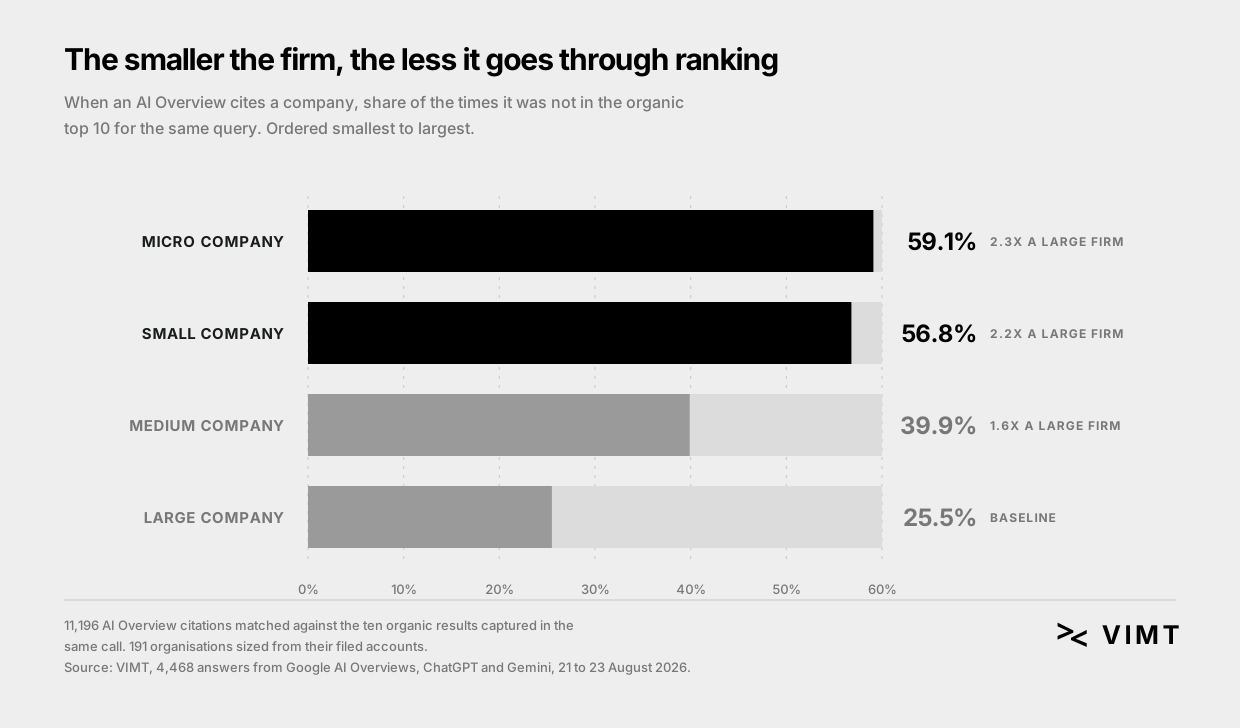 When a micro company is cited by AI Overviews, six times out of ten it was not in the
top 10 for that query. For a large firm, once in four. The progression is steady
across the four bands.
When a micro company is cited by AI Overviews, six times out of ten it was not in the
top 10 for that query. For a large firm, once in four. The progression is steady
across the four bands.
The obvious objection, and what it yields. One might think the effect comes from query length: small firms would appear mainly on long-tail questions, where competition is thin, and the query rather than the size would explain everything. The measurement does not bear this out. Separating short, mid and long queries, the gap between micro and large firms remains 33, 39 and 28 points. Separating by search volume, it remains 27, 42 and 26 points. The gradient is present in all six cases, and on the long tail it narrows slightly rather than widening.
It is worth taking in what this inverts. In classic search, position is the condition of everything: no top 10, no traffic. Here, Google's most visible surface lets in companies that were not in the top 10 beneath it, and it does so more the smaller they are.
Size, for that matter, is a poor predictor of presence in general. Mortgage One Finance files micro-entity accounts and appears on 88 different queries. Nationwide, on 99.
A concrete example. Google AI Overviews, question "Who are the best mortgage brokers in the UK?":
"The top-rated mortgage brokers in the UK include L&C Mortgages, Habito, Tembo, Better.co.uk, and Trinity Financial."
Trinity Financial is a London firm that files small company accounts. It is named alongside the four largest online broking brands in the UK, in the same sentence, on equal footing.
The qualification that stops this becoming a slogan
The door exists, but it rarely leads to an established presence.
Of 485 broker sites cited at least once, 364 are cited fewer than ten times across all 4,468 answers, with a median of two citations each. Appearing once is within reach of almost any firm. Appearing regularly is confined to about a hundred players.
The barrier to entry is low. So is the ceiling.
And ranking is not useless for all that: more than 1,700 times in this study, a domain occupies the top 10 without ever being picked up in the answer above it. Being well ranked is therefore not sufficient either. Both doors exist, they simply do not open the same way depending on size.
What each surface names, and what Google ranks
The same comparison extends to all three surfaces and both metrics: for each brand named and each source cited, did it also appear in the Google top 10 for that question?
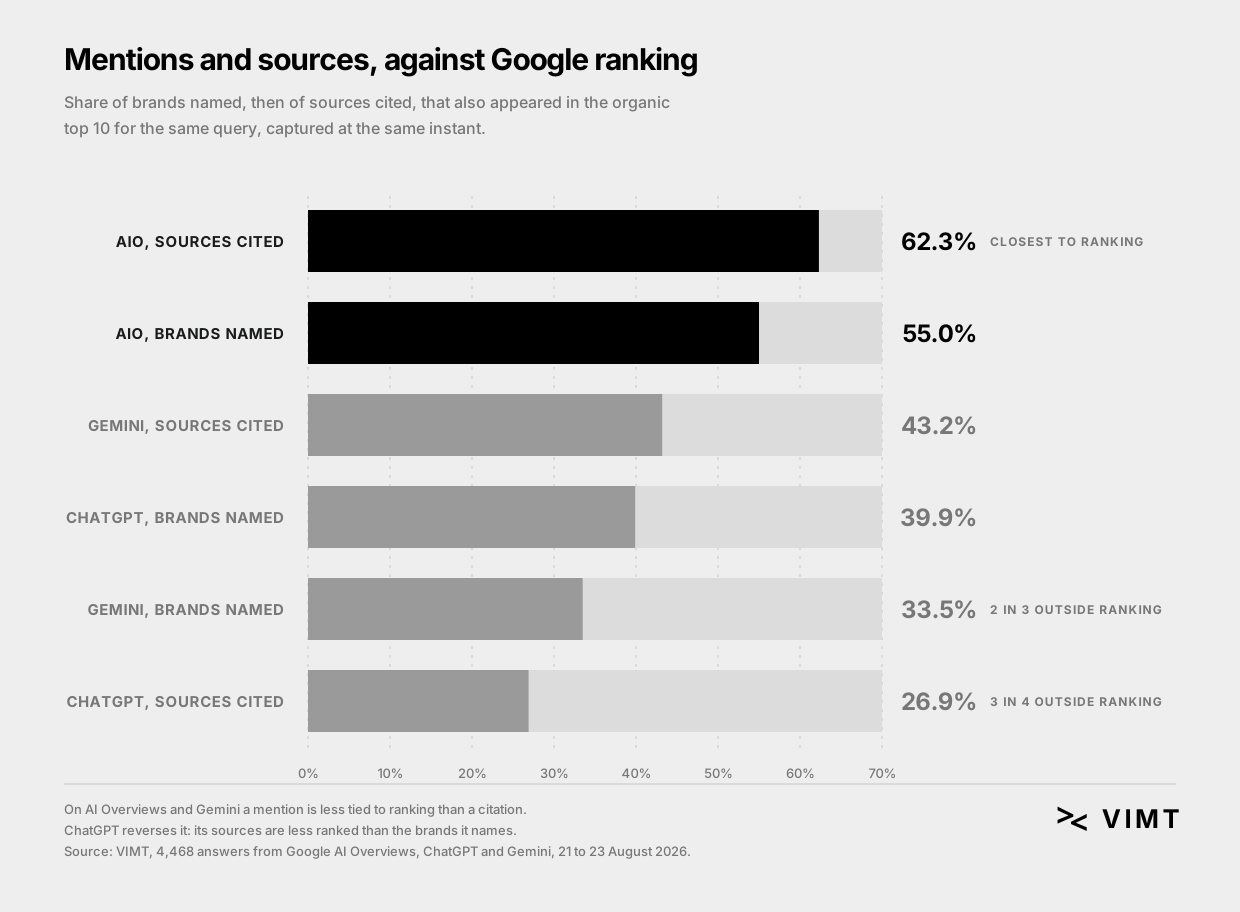 Two lessons follow.
The first: on AI Overviews and Gemini, a mention is less tied to ranking than a citation. A model names more freely than it sources. ChatGPT reverses it: its sources are even less ranked than the brands it names.
The second: two brands out of three named by Gemini are not in the Google top 10, and ChatGPT cites pages absent from it three times out of four. AI Overviews remain the closest to ranking, which is consistent with where they sit, but 45% of the brands they name are not there either.
The brand-level detail on Gemini shows the average covers opposite situations.
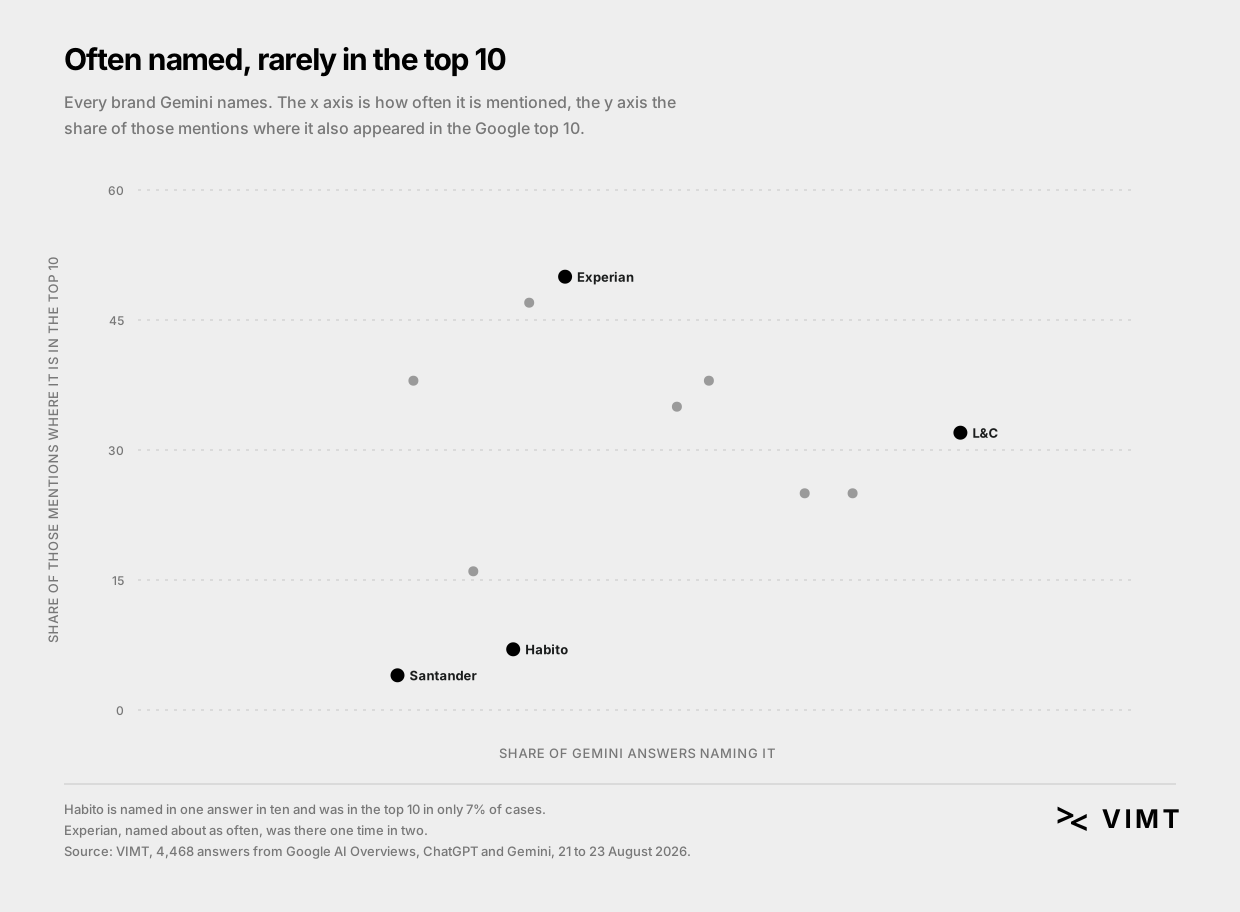 L&C is the brand Gemini names most, present in one answer in five, and it was ranked in
only a third of those cases. Habito is named in 141 answers and appeared in the top 10
only 10 times, that is 7%. Santander, 98 mentions for 4 rankings.
L&C is the brand Gemini names most, present in one answer in five, and it was ranked in
only a third of those cases. Habito is named in 141 answers and appeared in the top 10
only 10 times, that is 7%. Santander, 98 mentions for 4 rankings.
The other way round, on AI Overviews, MoneySavingExpert is named in 76 answers and was ranked in 71 of them, 93%. Moneyfacts, 64 out of 68. Both are almost always in the top 10 when they are named.
Two regimes therefore coexist on the same market: brands whose presence in answers follows ranking, and brands whose presence is almost independent of it.
5. Every trade has its moment
A lender, a broker and a comparison site do not sell the same thing, and the models do not call on them at the same moment. The difference is sharp, and it reads along the borrower's journey.
That journey runs through three stages. First understanding how something works, a fixed rate, a guarantor mortgage, a buy-to-let purchase. Then resolving a particular situation, self-employed, complex income, expat. Finally choosing a professional or a product.
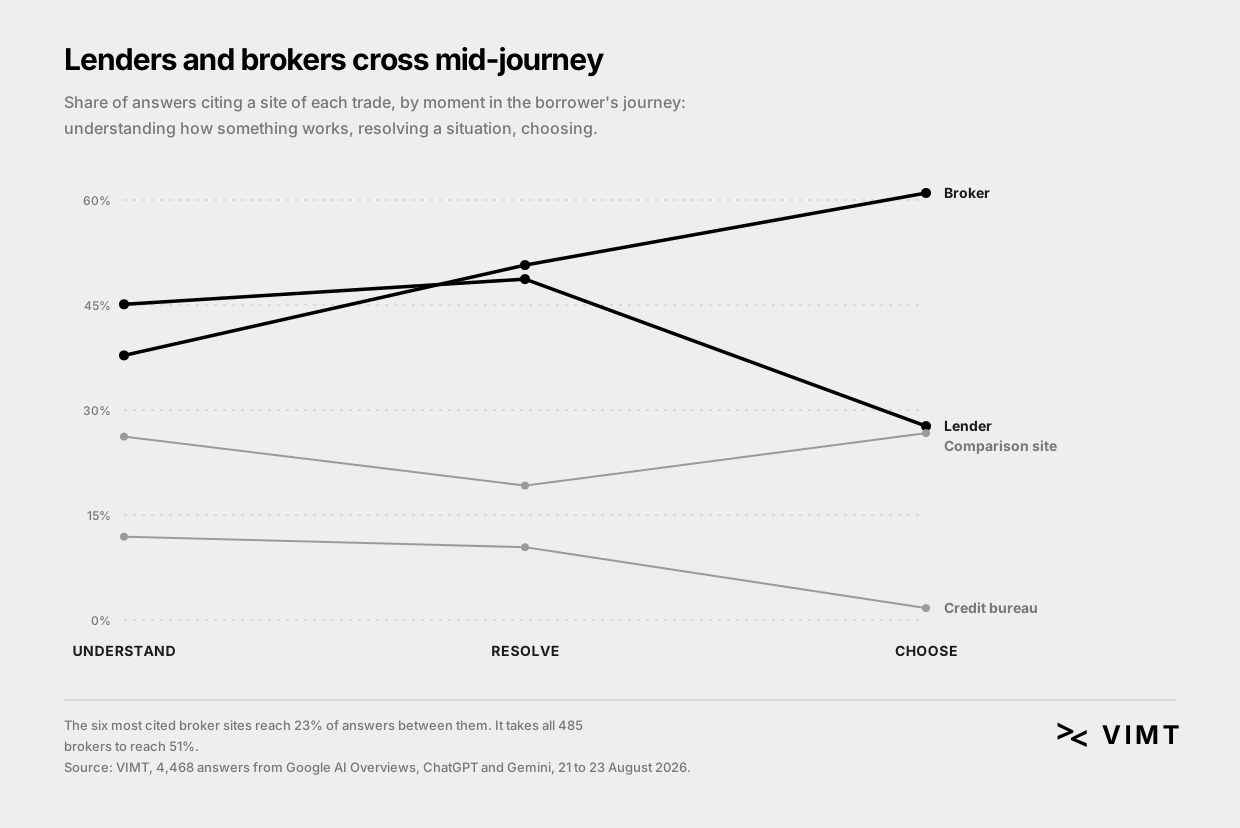 Everything in this section counts citations: the share of answers in which a site
belonging to that trade is cited as a source.
Everything in this section counts citations: the share of answers in which a site
belonging to that trade is cited as a source.
The lender dominates while the question is about explaining, cited in 45% of answers early in the journey, then falls seventeen points by the point of choosing. That follows: to explain how a fixed-rate mortgage works, a model cites the bank that documents it on its own site.
The broker travels the opposite way and takes the lead at the point of choice, from 38% to 61%. To point at someone to speak to, a model cites the firm whose trade that is.
The two curves cross in the middle, on questions about a borrower's own situation, where they are level.
The comparison site follows neither. It sits around a quarter of answers at both ends of the journey and dips to a fifth in the middle. It does not build across the stages the way the other two do, which is consistent with the raw-material role seen in section 3.
The credit bureau all but disappears at the point of choice, from 12% to 2%. Experian and its competitors are summoned to explain credit scoring, rarely to recommend a mortgage. That is the same finding as their position at the end of answers.
One framing figure, finally, which says something about the structure of this market: the six most cited broker sites reach 23% of answers between them, and it takes all 485 to reach 51%. No other trade on this market is spread that thin.
6. On reputation, it is the review sites that speak
Forums, review sites and video are often treated as a single family, the content a brand does not control. Grouped together they produce an average that hides the point. Separated, they tell three distinct stories.
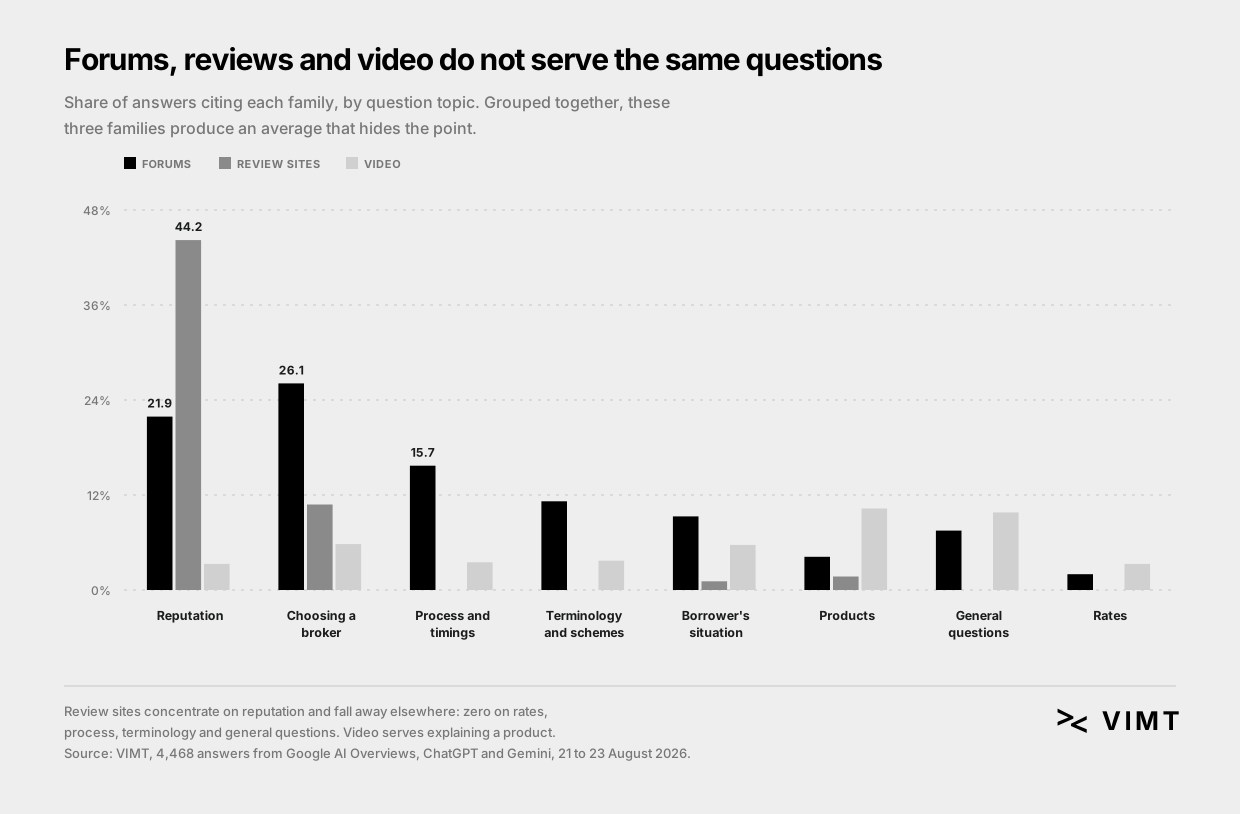 Review sites are concentrated on reputation. 44% of answers to reputation questions
cite one. They fall to 11% on choosing a broker and under 2% on every other topic. On
rates, process, terminology and general questions they are absent outright: zero, not
"few".
Review sites are concentrated on reputation. 44% of answers to reputation questions
cite one. They fall to 11% on choosing a broker and under 2% on every other topic. On
rates, process, terminology and general questions they are absent outright: zero, not
"few".
Forums serve choosing. Their peak is not on reputation but on choosing a broker, at 26%.
Video serves explaining a product. 10% on product questions, its high point, against 3% on rates.
And by stage of the journey, review sites go from zero at the understanding stage to 16% at the choosing stage. They exist only at the end.
The logic holds together. A rate is a fact, checked at the lender or at a comparison site. A reputation is a judgement, and a model goes looking for judgement where it is written down, which is with people who have been customers.
Which sites, exactly
| Site | Share of answers where it appears | Nature |
|---|---|---|
| reddit.com | 12.7% | forum |
| youtube.com | 6.0% | video |
| trustpilot.com and uk.trustpilot.com | 4.5% | customer reviews |
| facebook.com | 2.4% | social network |
| smartmoneypeople.com | 0.5% | customer reviews, finance specialist |
| quora.com | 0.2% | questions and answers |
| feefo.com | 0.2% | customer reviews |
Trustpilot occupies a single row but two addresses, the international domain and the UK subdomain. They are the same reviews, counted together.
The two doors do not serve the same engines, either. AI Overviews go through the UK version in 62 answers out of 72, Gemini goes exclusively through the international version, 88 out of 88. Twelve answers even point to the Australian, Canadian, Irish or New Zealand versions, on UK questions.
A word on social networks, since the question always comes up. Facebook, LinkedIn and TikTok together account for half of one per cent of all citations. It is not social networks that feed the AI on this market, it is forums and review sites.
Where the source appears in the answer
Position matters here too, and the order is stable across the two engines that report it.
Trustpilot arrives earliest, after 88 words on average on ChatGPT and 96 on Gemini, in the first quarter of the answer, where the model forms its judgement. Reddit falls in the middle, around 162 words on both. And gov.uk arrives last, after 392 words on ChatGPT, that is beyond the length of a median answer: it appears only in long answers, and right at the end.
A customer review serves to recommend. An official source serves to cover.
Methodology
501 questions in English sent to Google AI Overviews, ChatGPT and Gemini, three times each, from 21 to 23 August 2026: 4,468 usable answers, 25,642 sources cited. The three surfaces were queried through the DataForSEO AI Optimization API. Each question goes out as a single identical string to all three surfaces, so that any gap measured comes from the surface and not from the wording.
The question set is segmented on three axes, which are used to break down the results throughout the study.
By moment in the journey, that is, what the person is trying to do:
- Understand how something works,
- Resolve a particular situation,
- Choose a professional or a product.
By query length:
- Short tail,
- Mid tail,
- Long tail.
By topic, eight families:
- the borrower's situation,
- choosing a broker,
- rates,
- products,
- process,
- reputation,
- terminology and government schemes,
- general questions.
For each AI Overview call, the ten organic results for the same query were captured in the same call, at the same instant.
Each question was asked three times to provide an internal point of comparison, and to verify that the gaps between surfaces are not confused with the instability of each.
The 194 most cited organisations were documented one by one from their filed accounts at Companies House and from the FCA register. No size was inferred from citation counts.
What this study does not cover: Google ranking beyond the tenth position, languages other than English, behaviour beyond three days, and the consumer apps. The searches an engine runs are reported only by ChatGPT and Gemini, as is the position of sources within an answer. The study measures what is cited and named, not why.
One classification caveat. Every cited domain carries a broad type, and a subset also carries a precise trade. The breakdowns by trade in section 5 use the trade column, which is incomplete for comparison sites: six of them carry it, and Uswitch, MoneySavingExpert, Money.co.uk, GoCompare and Compare the Market do not, so they fall outside those tables. Lender and broker figures are unaffected; comparison-site figures should be read as a floor.
These surfaces move fast: ChatGPT's Reddit citations collapsed two weeks before this collection. It cites Reddit in 1.0% of its answers against 21.0% on AI Overviews and 16.3% on Gemini, and that 1.0% should be read as a snapshot rather than a property.
All figures are replayable from the raw answers, which have been retained. The full version, with the detailed methodology, the statistical control, the sections cut here and the data appendices, is available on request.